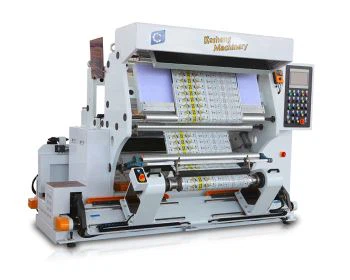
If you've ever sourced parts for small-scale flexible packaging or printing operations, you know that even a tiny rewinding machine's tension setting can make or break a finished roll. Too much tension, and you'll end up with stretched film, wrinkled edges, or even cracks in printed layers; too little, and the roll will be loose, prone to unraveling, or misaligned during storage or processing. As a small rewinding machine supplier, I get asked this question constantly: "What is the rewinding tension adjustment range of a small rewinding machine?" The answer isn't one-size-fits-all, though-it depends on a mix of design, intended use, and the materials you're working with. Let's break this down based on years of working with operators from specialty print shops, craft packaging studios, and small manufacturing teams around the world.
First, let's clarify what we mean by "small rewinding machine." For our team, that refers to benchtop to floor-standing models designed for low-to-medium volume runs, typically handling rolls with a core diameter up to 12 inches and a material width under 24 inches-perfect for soft packaging films, printed labels, thin foils, and lightweight paper. Larger industrial rewinders have broader ranges, but their adjustments are overkill for small operations, and their high costs don't make sense for teams that only process a few thousand feet of material a month. When we test and spec our small models, tension control is calibrated to balance precision and ease of use, which starts with understanding the two core types of tension: unwind tension and rewind tension. Most small machines allow adjustment for both, but the rewind range is what operators usually ask about first, since it directly impacts the final roll quality.
Now, to the numbers: For standard small rewinding machines, the typical rewinding tension adjustment range falls between 0.5 newtons per millimeter (N/mm) and 5 N/mm for most soft, thin materials. Wait, let's translate that into terms anyone can grasp-if you're working with 1-inch wide packaging film, that's roughly 0.02 pounds of force up to 0.22 pounds of force. That might sound tiny, but for a 12-inch wide roll, that scales to 0.24 pounds minimum and 2.64 pounds maximum. For context, a standard sheet of copy paper exerts about 0.005 pounds of force when held flat, so these settings are calibrated to apply just enough pressure to keep the roll tight without distorting the material. That range works for most common small-run jobs: polyethylene (PE) and polypropylene (PP) films for bakery or snack bags, BOPP (biaxially oriented polypropylene) for labels, and thin aluminum foil for food packaging. If you're using our Mini Re Reeling Machine for Soft Packaging, that range is locked in to cover these exact materials, with micro-adjustments that let fine-tune settings in 0.1 N/mm increments to avoid over-tightening delicate films.
But here's the thing: that baseline range changes depending on what you're processing, and not all small rewinding machines are built the same. For example, if you're working with printed materials, the tension range shifts slightly. Let's say you're running a Inkjet Print Rewinding Machine for small-batch product labels-your tension can't be too high, because it would cause ink smudging or transfer between adjacent layers of the roll. For these models, we adjust the rewinding tension range to 0.3 N/mm to 4 N/mm, narrowing the upper limit to keep ink layers intact while still preventing loose rolls. This is a key feature we engineered specifically for small print shops that don't have space for large dedicated print rewinding lines; the micro-tension controls let you process inkjet-printed rolls without sacrificing quality, even on runs of 500 to 10,000 labels.


For users needing even more precision, some specialized small rewinding machines offer extended tension ranges. Take the Automatic High-speed Single-side Inkjet Printing Inspection Rewinding Machine we supply for smaller batch inspection jobs-this model adds a tension range of 0.4 N/mm to 6 N/mm, designed for materials that are a bit thicker, like thin paperboard for product inserts or coated films for medical packaging. The added upper end of the range is useful here because coated materials are less prone to stretching, so you can apply a bit more tension to avoid slippage between the printed layer and the substrate, while the lower end still works for delicate, thin films.
Another common question I get is about reversible rewinding machines, used for jobs where you need to unwind a roll, process it, and rewind it in the opposite direction (like for duplex printing or slitting small rolls). For Reversible Rewinding Machine models, the tension range stays consistent for both directions-still 0.5 N/mm to 5 N/mm for standard applications-because the material's tension needs to stay uniform no matter which direction it's being rolled. We test these models with repeated forward and reverse runs to confirm that tension doesn't drift, which would cause wrinkles or alignment issues when flipping the roll for a second pass. For example, if you're slitting a 24-inch wide master roll into four 6-inch wide rolls on a Vertical Type Slitter Rewinder Machine for Plastic, the reversible setting ensures each slit roll has the same tightness whether it's being wound forward or backward, eliminating inconsistencies when the roll is sent to a label applicator or packaging line.
Now, let's talk about what factors affect this range-because it's not just a set number, it's adjustable. First, material thickness is the biggest variable. A 10-micron thin PE film needs the lower end of the range (0.5 N/mm to 2 N/mm), while a 50-micron thick PP film can handle 3 N/mm to 5 N/mm without stretching. Second, core size: a 1-inch diameter core for small labels will hold tension differently than a 3-inch diameter core for flexible packaging rolls, so our machines have core adapters that let you calibrate tension based on core size, expanding the usable range for different roll formats. Third, run length: long runs (over 1,000 feet) require slightly lower tension than short runs, because a longer roll will stretch as it builds up, so we build in auto-tension features that adjust as the roll diameter increases, keeping tension consistent across the entire run-something even small rewinding machines can do now, no manual adjustments needed.
I've also seen operators get tripped up by confusing tension units, so let's clear that up. Some manufacturers list tension in pounds per inch (lb/in) instead of N/mm, which can lead to mistakes. Our small rewinding machines display tension in both units on the digital control panel, so you don't have to do the math. For example, 0.5 N/mm is roughly 0.002 lb/in, and 5 N/mm is 0.02 lb/in-remember that number, and you'll never over-tighten a roll. Last year, a customer from a craft bakery reached out saying his small rewinder was wrinkling all his plastic bakery bags; he was setting the tension to 0.1 lb/in, way too high, because he was using a machine that listed tension in units he didn't recognize. We walked him through adjusting to 0.008 lb/in (0.35 N/mm), and his problem was solved-no more wasted bags, no more rework. That's the kind of small win that makes me focus on clarity, not just specs, when talking about rewinding tension.
It's also worth noting what small rewinding machines can't do, because that helps set expectations. If you're processing materials over 60 microns thick or rolls wider than 20 inches, you might want a mid-sized rewinding machine with a higher upper tension limit (up to 10 N/mm or more). But for most small operations-from specialty print shops and craft packaging studios to small medical device manufacturers and educational labs-the small rewinding machine's tension range is perfectly calibrated to their needs. We've tested our models with over 50 different materials, from tissue thin PVA films for dissolvable packaging to thick cardstock for gift tags, and the tension range holds up across all of them, as long as operators select the right setting for their material.
Another point: tension control isn't just about the settings on the machine-it's about how the machine applies that tension. Our small rewinding machines use either friction brake tension or magnetic particle tension, both of which are designed for fine adjustment. Friction brakes are the most common on benchtop models, offering a simple twist knob for tension adjustment, while magnetic particle brakes on floor-standing models let you make micro-adjustments with a digital dial. All of our models have a tension feedback system that measures the force on the material as it's being rewound, so if the tension drifts (which can happen as the roll builds up), the machine automatically adjusts to keep it consistent. That's a key feature that many budget small rewinding machines skip, but it's the difference between a tight, uniform roll and a loose, wrinkled mess.
If you're still unsure what tension range is right for your operation, the best way is to test a sample of your material on a small rewinding machine. We always encourage potential customers to request a test run-just send us a small roll of your material, and we'll process it on our models so you can see firsthand how the tension performs. For example, if you're processing inkjet-printed labels, we can test the Inkjet Print Rewinding Machine and show you how the tension setting keeps ink from smudging while producing a tight, roll that won't unravel during shipping. For soft packaging films, we can test the Mini Re Reeling Machine for Soft Packaging and adjust tension to match your desired roll tightness, so you don't have to guess when you get the machine at your facility.
At the end of the day, the rewinding tension adjustment range of a small rewinding machine isn't just a number on a spec sheet-it's a critical feature that affects every roll you produce. Whether you're running small-batch prints, custom packaging, or specialty materials, the right tension setting can cut down on waste, improve roll quality, and make your operation run smoother. As a supplier, my goal isn't just to sell you a machine-it's to make sure you have the information you need to get the most out of it, and that means being transparent about what the tension range can and can't do for your specific application.
If you're ready to discuss your small rewinding needs, or want to learn more about how our machines can work for your operation, get in touch to explore solutions tailored to your materials and production volume.