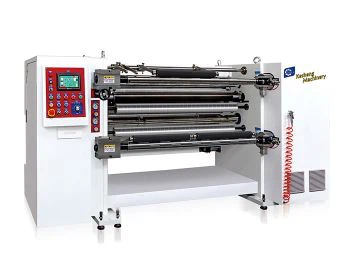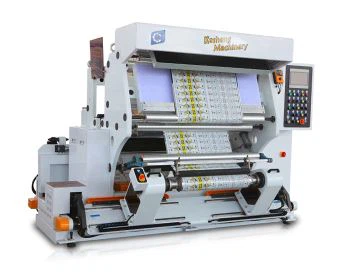
As a reputable supplier of Reversible Rewinding Machines, I am often asked about the control systems that make these machines so efficient and versatile. In this blog post, I will delve into the various control systems of a Reversible Rewinding Machine, explaining how they work and their importance in the overall operation of the machine.
1. Programmable Logic Controller (PLC)
The Programmable Logic Controller, or PLC, is the heart of the control system in a Reversible Rewinding Machine. A PLC is an industrial computer that can be programmed to control various machine functions. It receives input from sensors placed throughout the machine and uses this information to make decisions and send output signals to actuators, such as motors and solenoids.
In a Reversible Rewinding Machine, the PLC is responsible for controlling the speed, direction, and tension of the rewinding process. For example, it can adjust the speed of the rewinding motor based on the diameter of the roll being wound. As the roll diameter increases, the PLC can slow down the motor to maintain a consistent tension. This ensures that the material being rewound is not stretched or damaged.
The PLC also allows for easy programming and customization of the machine's operation. Operators can set different parameters for different types of materials or production runs. This flexibility makes the Reversible Rewinding Machine suitable for a wide range of applications, from Label and Paper Rewinding Machine to Automatic High Speed Rewinding Machine.
2. Tension Control System
Tension control is crucial in a Reversible Rewinding Machine to ensure that the material being rewound is wound evenly and without wrinkles. The tension control system uses sensors to measure the tension of the material at various points in the rewinding process. These sensors send signals to the PLC, which then adjusts the speed of the motors to maintain the desired tension.
There are two main types of tension control systems: open-loop and closed-loop. In an open-loop system, the tension is set manually, and the machine operates at a fixed speed. This type of system is suitable for applications where the tension requirements are relatively constant. However, in a closed-loop system, the tension is continuously monitored and adjusted by the PLC. This provides more precise control and is ideal for applications where the tension needs to be maintained within a narrow range.
The tension control system also plays a role in preventing material breakage. If the tension becomes too high, the PLC can slow down the motors or stop the machine to avoid damaging the material. On the other hand, if the tension is too low, the material may not be wound tightly enough, leading to loose rolls.
3. Speed Control System
The speed control system in a Reversible Rewinding Machine is responsible for regulating the speed of the rewinding process. This is important to ensure that the material is wound at the appropriate speed for its type and thickness. The speed control system works in conjunction with the tension control system to maintain a consistent tension while the machine is operating.
There are several ways to control the speed of a Reversible Rewinding Machine. One common method is to use a variable frequency drive (VFD). A VFD is an electronic device that can vary the frequency and voltage of the electrical power supplied to the motor. By changing the frequency, the VFD can control the speed of the motor. This allows for smooth and precise speed control, which is essential for high-quality rewinding.
Another method of speed control is to use a servo motor. A servo motor is a type of motor that can be controlled very precisely. It uses feedback from a position sensor to adjust its speed and position. Servo motors are often used in high-speed and high-precision applications, such as Automatic High Speed Rewinding Machine.
4. Direction Control System
As the name suggests, the direction control system in a Reversible Rewinding Machine is responsible for controlling the direction of the rewinding process. This is important because some materials need to be rewound in a specific direction to ensure proper alignment and quality. The direction control system allows the operator to switch the direction of the rewinding motor easily.
The direction control system is typically controlled by the PLC. The operator can select the desired direction through a control panel or a touch screen interface. Once the direction is selected, the PLC sends a signal to the motor to change its rotation direction. This process is usually very fast and smooth, allowing for quick changes in the rewinding direction.
5. Safety Control System
Safety is a top priority in any industrial machine, and a Reversible Rewinding Machine is no exception. The safety control system in a Reversible Rewinding Machine is designed to protect the operator and the machine from potential hazards. It includes various safety features, such as emergency stop buttons, safety guards, and sensors.
Emergency stop buttons are located at easily accessible locations on the machine. In case of an emergency, the operator can press the emergency stop button to immediately stop the machine. Safety guards are used to prevent the operator from coming into contact with moving parts of the machine. These guards are interlocked with the control system, so if the guard is opened, the machine will automatically stop.


Sensors are also used in the safety control system to detect any abnormal conditions. For example, if a sensor detects that the tension is too high or the speed is too fast, it can send a signal to the PLC to stop the machine. This helps to prevent accidents and damage to the machine.
Importance of Control Systems in a Reversible Rewinding Machine
The control systems in a Reversible Rewinding Machine are essential for its efficient and reliable operation. They ensure that the material is rewound evenly, at the correct speed and tension, and in the right direction. This not only improves the quality of the rewound product but also increases the productivity of the machine.
In addition, the control systems provide a high level of safety for the operator. By incorporating various safety features, the machine can prevent accidents and protect the operator from potential hazards. This is especially important in a high-speed and high-power environment, where even a small mistake can have serious consequences.
Contact for Purchase and Negotiation
If you are interested in purchasing a Reversible Rewinding Machine or have any questions about our products, please feel free to contact us. Our team of experts is ready to assist you in finding the right machine for your specific needs. We offer a wide range of Double Side Mini Rewinding Machine for Flim and other rewinding machines, and we can also provide customized solutions to meet your unique requirements.