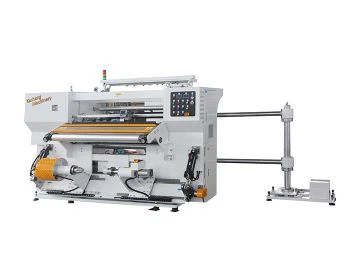
If you're in the business of plastic film-whether you're a flexible packaging converter, a label manufacturer, a food producer, or a company that makes disposable consumer goods-you've likely relied on rewinding machines at some point. But if you're new to sourcing this equipment, you might be asking: What is the production capacity of plastic film rewinding machines? The answer isn't a one-size-fits-all number; it depends on variables like machine type, film material, web width, speed, and the complexity of your rewinding job. As a supplier of plastic film rewinding machines that've been installed in facilities across North America and Europe over the past decade, I've seen firsthand how misunderstanding capacity leads to overspending on underperforming equipment or scrambling to meet production deadlines with machines that can't keep up. Let's break this down realistically, no industry jargon designed to confuse, just the facts you need to make an informed choice.
First, it's important to clarify that "production capacity" for rewinding machines isn't measured in total hours of operation-it's two interlocking metrics: linear speed (how fast the film moves through the machine, in meters or feet per minute) and finished roll output (how many full, usable rolls you can produce per hour, based on core size, roll diameter, and web width). But those numbers aren't static. A machine that runs 1,000 feet per minute on thin, uncoated polypropylene will produce far more output than the same machine running at 800 feet per minute on thick, rigid PVC with multiple layered adhesives. That's why many of my customers start by assessing their specific needs before locking in on a machine, rather than fixating on generic capacity claims.
Let's start with the most common categories of plastic film rewinding machines, since each has distinct capacity ranges tied to their design. First, there's the Automatic High Speed Rewinding Machine line, which is built for high-volume, continuous production runs. These machines are the workhorses for large converters producing thousands of feet of film daily for grocery store bags, shrink wrap, or shipping packaging. Their typical maximum linear speed tops out at 1,500 feet per minute (457 meters per minute), but I've seen custom models for specialized films hit 1,800 feet per minute. At that speed, a 60-inch web width machine running on 1-millimeter-thick low-density polyethylene (LDPE) can produce finished rolls at a rate of 20 to 25 rolls per hour, depending on core size (most standard cores for this application are 3 inches in diameter, with finished roll diameters of 12 to 18 inches). That translates to roughly 25,000 to 30,000 linear feet of finished film per hour-enough to supply a mid-sized regional packaging plant for a full shift.
But not every operation needs that kind of power. For small to mid-sized businesses, or operations that run short production runs for specialty films, the Mini Rewinding Machine fills a key niche. These compact machines are designed for lower throughput, with linear speeds ranging from 100 to 600 feet per minute, and web widths up to 20 inches. Their capacity tops out at just 5 to 8 finished rolls per hour, with total linear output of 2,000 to 5,000 feet per hour. I regularly recommend these to label printers or small food producers that only need to rewind small batches of film for custom orders, since they take up far less floor space and cost a fraction of a high-speed model-no need to pay for capacity you'll never use.
If your work involves label film specifically, you'll want to consider the Label Rewinder Machine subset, which has unique capacity parameters tailored to narrow webs and precise roll tolerances. Most label rewinding machines run at speeds between 300 and 1,000 feet per minute, with web widths from 0.5 inches to 20 inches. Their capacity is measured not just in linear feet, but in roll count per hour (since labels have consistent, narrow dimensions) and accuracy-many have slitting and inspection functions that mean you're not just rewinding, but also checking for defects as you go. A standard label rewinder will produce 50 to 100 finished label rolls per hour, which is perfect for the small batch, high-variety runs that define the label industry. It's important to note that label rewinding machines are a specialized type, so they're not designed for wider plastic film-always match your machine to the type of material you'll be processing.


Another category that often comes up for customers handling reversible films (like stretch wrap or certain types of agricultural film) is the Reversible Rewinding Machine. These machines are designed to rewind film in either direction, which prevents curling or tension issues that can ruin thin, flexible films. Their capacity is slightly lower than standard high-speed models, topping out at 1,200 feet per minute, with finished roll output of 15 to 20 rolls per hour for standard LDPE. The tradeoff here is worth it for applications where film curling would lead to wasted material-we've had customers switch from standard high-speed machines to reversible models and cut scrap rates by 12%, which makes the slight capacity difference negligible in the long run.
Now that we've covered machine-specific capacity, let's talk about the factors that can make a machine's actual output vary from the manufacturer's quoted number. First, film thickness and material makeup. Thin films (0.001 to 0.005 inches) like standard grocery bag LDPE can run at higher speeds because they're flexible and easy to handle, while thicker films (0.01 to 0.05 inches) like rigid PVC or polyester require slower speeds to avoid stretching or tearing. For example, a high-speed machine that hits 1,500 feet per minute on thin LDPE will only run at 900 to 1,100 feet per minute on thick polyester, cutting its linear output by 40% to 50%. That's why we always test sample material from a customer's facility before quoting capacity-no two films behave the same, so generic numbers can be misleading.
Second, roll specifications. The size of your finished roll (core diameter and total roll diameter) directly impacts how many rolls you can produce per hour. A larger core (like 6 inches instead of 3 inches) means you can fit more linear feet on each roll, so fewer total rolls, but the machine can run longer before needing to change cores. Conversely, smaller cores mean more frequent core changes, which cuts into available production time. Most of our machines are adjustable to handle core sizes from 1 inch to 6 inches, and we work with customers to find the sweet spot between roll size, changeover time, and total output.
Third, automation features. Machines with automatic core loading, automatic roll changeover, and built-in defect inspection will have higher effective capacity than manual machines. A fully automatic high-speed rewinding machine can change rolls in less than 30 seconds, while a manual machine takes 2 to 3 minutes per change-over an 8-hour shift, that adds up to almost 2 hours of lost production time, cutting total output by 25%. For customers running large, continuous shifts, investing in automated features is almost always worth the cost, as the higher capacity pays for itself in saved labor and reduced downtime.
I've seen too many customers make the mistake of choosing a machine based solely on its maximum claimed speed, only to find that their specific application can't take advantage of that capacity. Last year, a mid-sized flexible packaging converter came to us after purchasing a used high-speed rewinding machine from a overseas supplier, thinking it would double their output. But they were running 0.02-inch thick nylon film, which could only be processed at 600 feet per minute-half the machine's rated speed. On top of that, their manual core changeover meant they only produced 1,200 linear feet per hour, far below what they needed. We swapped out their old machine for a standard Plastic Film Rewinding Machines model rated for a maximum of 1,000 feet per minute, optimized for thick nylon film, and added automatic roll changeover. Their output jumped to 2,800 linear feet per hour, and scrap rates dropped because the machine had tension control tailored to their film. They saved almost $50,000 a year in production costs, just by matching machine capacity to their actual needs.
Another way to contextualize capacity is to think about it relative to production needs. If you're a small business producing 50,000 linear feet of film per week, a Mini Rewinding Machine with 5,000 linear feet per hour capacity is more than enough-you'd only need 10 hours of production per week, which fits easily into a part-time schedule. If you're a large converter producing 500,000 linear feet per week, you'll need multiple Automatic High Speed Rewinding Machines with total capacity of 8,000 to 10,000 linear feet per hour, plus back-up machines to avoid downtime. Most facilities we work with size their capacity to 120% of their maximum weekly demand, to account for maintenance, changeovers, and unexpected film quality issues-this prevents the stressful situation of falling behind on orders.
It's also important to consider long-term capacity needs. A business that's growing fast might outgrow a Mini Rewinding Machine in a year or two, so we often recommend investing in a slightly higher capacity machine that can handle future growth, rather than buying a machine that will become obsolete quickly. The Automatic High Speed Rewinding Machine line, for example, has adjustable speed settings that let customers start at 80% of maximum speed to avoid stressing the machine, then crank it up as their production volume increases. That flexibility is a big selling point for businesses that are scaling up.
Now, let's address a common misconception: higher speed doesn't always mean better capacity. For some applications, slower, more precise rewinding is more valuable than maximum linear speed. If you're producing film for medical packaging, for example, the roll needs to be perfectly smooth and defect-free to ensure the packaging seals correctly, so running at top speed might lead to more defects, even if it's faster. In that case, a machine with slightly lower speed (800 feet per minute) but advanced tension control and inspection systems will have higher effective capacity because you're not wasting material on scrap. We had a medical device client switch from a high-speed machine to a mid-speed model with full defect scanning, and their scrap rate dropped from 8% to 1.5%, resulting in a net gain in usable film output even though the machine's linear speed was lower.
So, how do you determine the right production capacity for your plastic film rewinding operation? Start by answering a few key questions: What is the thickness, width, and type of plastic film you'll be processing? What's your weekly or monthly production volume? Do you need to run short, custom batches or long, continuous runs? Do you need features like slitting, defect inspection, or reversible rewinding? Once you have those answers, you can work with a supplier to match you to a machine that has the right capacity for your needs.
At the end of the day, the production capacity of a plastic film rewinding machine isn't just a number-it's a tool that's designed to fit your specific business. Whether you're a small label printer needing a compact Mini Rewinding Machine or a large converter needing the power of an Automatic High Speed Rewinding Machine, the key is to avoid chasing generic capacity claims and instead focus on what will actually help you meet your production goals, reduce costs, and scale your business.
If you're ready to explore which plastic film rewinding machine is right for your operation, we're here to help. We provide customized testing for your specific film materials, detailed capacity calculations tailored to your production needs, and ongoing support to ensure your equipment runs at peak performance.