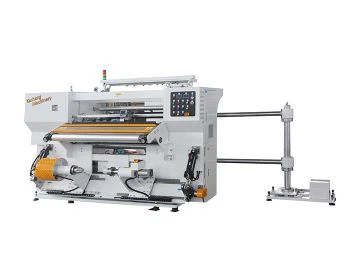
If you've ever stood next to an Aluminium Foil Slitting Machine running at full tilt, you might have felt a faint hum through the floor, or even a gentle vibration in your hands if you're adjusting a component. But what's normal for this equipment's vibration level, and why does it matter? As a supplier who's spent years fine-tuning these machines for manufacturers across food packaging, pharma, and household foil production, I can tell you this isn't a trivial question. Too much vibration cuts into product quality, shortens machine life, and wastes material-but too little might even be a sign something's off. Let's break this down from the perspective of someone who troubleshoots these machines every week, not just a textbook.
First, a quick primer on how these machines work, because vibration starts with their core function. An Aluminium Foil Slitting Machine takes large, heavy "jumbo rolls" of foil (often stored at 1-2 tons each) and slices them into smaller, precise rolls for kitchen use, food containers, or pharmaceutical packaging. The process relies on a series of rotating components: unwinder shafts that hold the jumbo roll, slitting blades (usually razor-sharp or shear blades), tension control systems, and rewinder shafts that wind the finished smaller rolls. Each of these parts generates movement, and when misaligned, unbalanced, or poorly maintained, that movement turns into vibration.
To get specific, let's talk about the vibration levels we see in our own machines, both in our factory testing facilities and at customer sites. Vibration is measured in two common ways for industrial machines: velocity (in millimeters per second, mm/s) and displacement (in microns, µm, which is one-thousandth of a millimeter). For precision slitting equipment like ours, the baseline "healthy" vibration levels are lower than for bulk industrial machinery, because even tiny movements can ruin a cut.
In our testing, when we run a standard Automatic Aluminum Foil Laminated Plastic Film Slitting Machine at its rated speed (usually 300 to 600 meters per minute, depending on the model), the overall vibration across the machine's main body sits between 1.5 and 3.0 mm/s on the velocity scale. That's roughly the vibration level of a quiet refrigerator running in the next room-not something you'd notice unless you were paying attention. The critical components, though, where vibration has the biggest impact on slitting quality, have even lower levels. The slitter module itself rarely tops 2.0 mm/s, because any more would cause the blades to wander, leaving wavy edges on the foil, or even tear the thin foil (many foils used today are just 7 to 20 microns thick-thinner than a human hair).
Wait, I know what you're thinking: "That's for new machines. What about used ones?" Great question. As a supplier, I get calls all the time from customers who bought a second-hand Aluminum Foil Automatic Slitting Machine and are seeing high vibration. For mid-life machines (5 to 10 years old, with regular maintenance), we still aim for the same 1.5-3.0 mm/s baseline, but the slitter module might creep up to 3.5 mm/s if the blades are dull or the bearings are wearing. If it hits 5.0 mm/s or higher, that's a red flag-we've had customers send videos of their machines at 6 mm/s, and within a week they were wasting 10-15% of their jumbo rolls due to uneven slitting.


Let's talk about what causes these vibration spikes, because that's more useful than just numbers. The most common culprit we see is unbalance in the unwinder or rewinder rolls. A jumbo roll of foil isn't perfectly round or evenly wound-even a tiny wobble of 0.5 mm on the shaft creates a lot of vibration at high speeds. That's why in our Fully Automatic Aluminum Foil Slitting Machine, we include an automated balancing system for the rolls; it corrects for that tiny wobble before the roll even starts turning, keeping vibration low. Another big one is blade alignment: if the top and bottom slitting blades are even 0.1 mm out of line, that creates friction and vibration that travels through the entire machine. We test blade alignment to within 0.05 mm on all our machines, which is why our customers rarely deal with that issue.
Speed also plays a huge role. A High Speed Aluminium Foil Roll Slitting and Rewinding Machine running at 800 m/min will have higher vibration than a lower-speed model, but we design our high-speed units to compensate. For example, we use heavier-duty bearings and stiffer machine frames to absorb vibration at higher speeds, so even at maximum output, the overall vibration stays under 3.0 mm/s. I've seen a cheap, off-brand slitter running at 500 m/min hit 5 mm/s, which is double our level, and that machine would jam at least once a week. The difference is in the engineering, not just the speed.
Now, why does all this matter for your production? Let's use a real example from a customer in Mexico who reached out to me last year. They were running a used jumbo roll slitting machine for aluminium foil, and their finished rolls were getting rejected because of uneven edges. Their vibration was measuring at 4.8 mm/s on the slitter module. We sent our technician to check, and he found that the bearings on the rewinder shaft were worn, and the unwinder roll was 2 mm out of balance. After replacing the bearings and rebalancing the roll, their vibration dropped to 2.2 mm/s, and their reject rate went from 12% to less than 1%. That's not a small difference-saving 11% of material on a 20-ton monthly jumbo roll order translates to thousands of dollars in savings every month.
I should also mention that different types of foil and laminated materials affect vibration too. If you're slitting plain aluminium foil (single layer, thin), the required vibration level is much lower than if you're slitting laminated plastic-aluminium film, which is thicker and stiffer. The Automatic Aluminum Foil Laminated Plastic Film Slitting Machine we sell is calibrated to adjust vibration settings for the material type, which is why it's a popular choice for companies that process multiple foil products. For laminated materials, we aim for overall vibration under 3.5 mm/s, because the thicker material can handle a bit more movement without damage, but still needs precise cuts.
How do you measure vibration yourself, by the way? You don't need expensive lab equipment-there are portable vibration meters that cost a few hundred dollars, which most maintenance teams can operate. We recommend measuring vibration at four key points: the unwinder shaft, the slitter module, the tension control unit, and the rewinder shaft. If any of these points are over 4.0 mm/s, it's time for maintenance: check bearings, balance the rolls, align the blades. If they're over 5.0 mm/s, you should stop running the machine until you fix it, because you're risking permanent damage to the components.
As a supplier, our job isn't just to sell you a machine-it's to make sure it runs well for years, which is why we include vibration testing as a standard part of our pre-delivery inspection. Each of our machines, from the basic Aluminum Foil Automatic Slitting Machine to the high-speed model, undergoes 2 hours of testing at full speed before it leaves our factory, with vibration readings recorded and provided to the customer. We also offer on-site calibration and maintenance services for any of our models, so if you ever notice unusual vibration, we can send a technician to check it out quickly.
I've had customers tell me they thought higher vibration meant the machine was "working harder," but that's a myth. A well-tuned slitting machine runs quietly, with minimal vibration, because all its components are working in sync. When you feel a machine shaking enough to rattle tools off the nearby bench, that's energy being wasted on movement instead of cutting. For small manufacturers just starting out, investing in a machine with controlled low vibration is way better than buying a cheap machine that will cost you in material waste and repairs down the line.
If you're in the market for a slitting machine and want to see the actual vibration test data for our models, or learn more about how our equipment is calibrated for precision, I'd encourage you to explore our range of Automatic Aluminum Foil Laminated Plastic Film Slitting Machine, Aluminum Foil Automatic Slitting Machine, Fully Automatic Aluminum Foil Slitting Machine, Jumbo Roll Slitting Machine For Aluminium Foil, or High Speed Aluminium Foil Roll Slitting and Rewinding Machine. Each of these is designed to keep vibration at healthy levels, no matter the production volume or material type.
At the end of the day, vibration level isn't just a technical spec-it directly impacts your bottom line. Too much vibration means wasted material, more maintenance costs, and higher reject rates. Too little vibration might seem like a plus, but if your machine is running at under 1 mm/s when it should be at 2-3 mm/s, that might mean it's underperforming, not reaching its full speed, which cuts into your production output. Finding that sweet spot, usually between 1.5 and 3.5 mm/s depending on the machine and material, is key to efficient, high-quality slitting.
If you have questions about your current machine's vibration levels, or want to discuss which of our slitting machines would work best for your production needs, feel free to reach out for a consultation. We're here to help you keep your operations running smoothly, with minimal vibration and maximum results.